
Introducing Localingo
Localingo is a real-time meeting translation platform designed to preserve intent across languages.
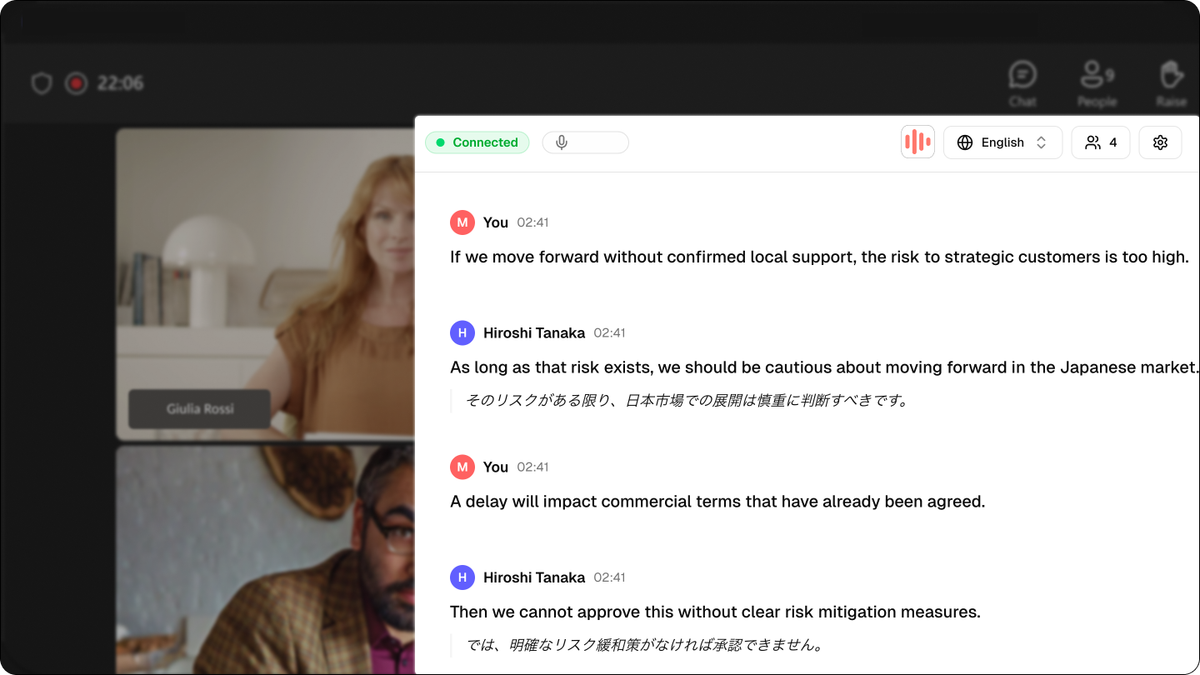
Translation accuracy is about more than just linguistic accuracy. It’s also about cultural and industry awareness as well as subject expertise.
Our goal is to allow people to wield their intention with confidence, as they would in their own language, across as many borders as they have occasion to.
The current landscape
Unfortunately, while some languages are prevalent and somewhat spoken worldwide, non-native speakers make every effort to make themselves understood. What ends up happening more often than not is one cohort ends up speaking the dominant language.
When having business meetings, this is painfully obvious - everyone feels uncomfortable for two reasons (or four depending on how you look at it):
1. Mutual Comprehension: Both native and non-native speakers wish they could understand and be understood better.
2. Mutual Assurance: Both the non-native and native speakers wish they could assure the others that they are understood and that they are understanding correctly.
It’s frustrating because everyone would like to help each other understand better and while there is every willingness, it is an unwieldy process involving sharing screens and copy pasting across tools like Google Translate or DeepL in another tab.
As more companies operate across borders by default, communicating across languages becomes a daily operational requirement.
- Startups expand into new markets faster than they can hire native teams in each region. Go-to-market efforts plateau when messaging doesn’t fully resonate outside the home market.
- Supplier evaluation becomes fragile when relying on single-language templates that are designed for a single regulatory environment. Capable partners are excluded simply because communicating across languages requires additional effort and uncertainty.
- Third party risk management platforms and compliance tools provide useful data, but data does not replace direct conversation. When working with international manufacturers or distributors, the ability to communicate clearly and confidently matters more than an API response.
In each of these cases, the limiting factor is not opportunity. It is communication.
Context in translation
While the efficacy of communication tools is often measured in benchmarks — BLEU scores, word error rates, latency — those metrics only capture surface correctness. They do not measure whether intent survives the crossing.
A translated phrase can be both grammatically flawless and strategically wrong. The “lowest hanging fruit” example of this is corporate jargon translated from English into pretty much any language, sounds ridiculous and makes no sense. To take our toy example, if one were to say “frutti a bassa pendenza” in Italian, it would completely detract from the conversation if the translation were not simultaneously culturally aware and sensitive to a particular industry jargon.
Further, there is “one other layer to peel” here. If our translator in our Italian example came up with “obiettivi facili”, it has arguably achieved its purpose from an accuracy standpoint. If we were to retranslate this back into English, we would end up with “easy objectives” which anyone would agree is synonymous with “low hanging fruit”. However, it turns out that certain language pairs seem to have a similar propensity to favouring idioms and turns of sentence for particular intents over plain language. Our Italian translator would be even more impressive if it therefore managed to come up with “a portata di mano”, which is much closer to our English intent. If retranslated back into English by a similarly talented translator, we would more likely get something like “at one’s fingertips” or indeed “low hanging fruit”.

Not every situation is as clear cut as the one I have described above. Sometimes intent can drift over the course of minutes, perhaps making a confident statement seem cautious or causing an instruction to become a suggestion.
In many settings, this drift generally happens a lot earlier, when one party decides it is a lot easier to “just speak the other language”. Depending on the skill, it alleviates some friction and provides some fluency for the overall conversation, while coming across as respectful, maybe even efficient! It introduces a different kind of distortion, critical to the goal at hand. If not immediately after a conversation, reduced nuance, risk avoidance, and oversimplification amounts to a lack of confidence over time. The constraints of the language gives rise to doubts and a sense that new blind spots are introduced every step of the way.
This is the real cost of global business in a dominant language environment. It’s not that people can’t communicate, but that they can’t communicate fully.
Intent as part of accuracy
We treat intent as part of accuracy. Our mission is simple: enable people to understand and be understood without diluting intent, preserving the industry knowledge, cultural framing, and situational stakes that shape how a message is received.
In a negotiation, phrasing carries leverage. In a sales call, tone carries authority. In a partnership discussion, nuance carries trust.
When you can preserve these elements, your collaboration becomes less fragile. Conversations feel shorter, clearer, decisive, and you’re not left wondering if you came across as you should have after your call.
Our goal is not perfection, but parity between how people speak at home vs abroad.
A higher standard
Global business increasingly depends on people working across languages. Yet most cross-border meetings still default to a compromise: someone switches languages, vocabulary narrows, nuance thins, and the conversation moves forward anyway.
That compromise has become normal. It keeps discussions functional. But functional is not the same as precise. There is no inherent reason that depth must always be traded for shared fluency. As language technology improves, the constraint becomes less technical and more structural, embedded in habit and workflow rather than capability.
Real-Time Translation for Meetings That Preserves Intent
Instead of managing separate translation tabs or defaulting to one dominant language, participants can speak in the language they think in, removing a great deal of cognitive load. Real-time AI interpretation runs in parallel, coordinated through a contextual layer that reflects the industry and setting of the discussion. The goal is not to rewrite how people speak, but to ensure that what they mean is what others receive.
No copy-paste workflows, no linguistic self-suppression as a prerequisite, no reduction in depth just to keep the meeting moving.
Localingo is built around that simple objective: help people understand and be understood, fully, across languages.
International collaboration should not require simplification as the price of participation.